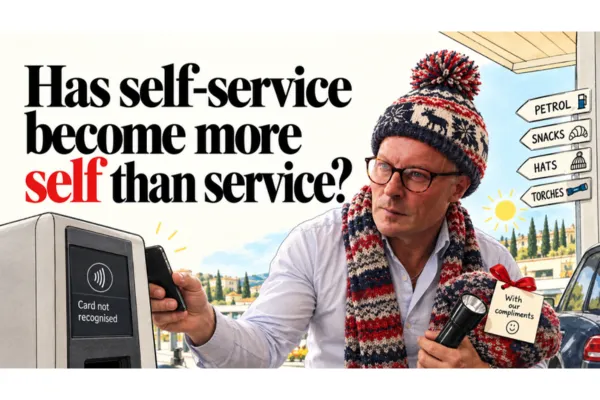
HAS SELF-SERVICE BECOME MORE SELF THAN SERVICE?
I have always thought the petrol pump was one of the better examples of self-service. You arrived. Got out. Removed your card from your wallet. Put it in the machine. Then popped in your PIN.
I’ve always been jealous of my friend John. He was born on the 11th of November. It’s the Rolls-Royce of dates of birth. I’ve even considered changing mine. If you could do it by deed poll, I would. I’d have John’s. Because then I’d never, ever forget my PIN. As it is, I couldn’t possibly use 1111. That’s not my date of birth.
Anyway, PIN entered, you could fill your car with petrol without having to involve another human being at all. And Bob was your uncle. Subject, obviously, to nobody blocking the Strait of Hormuz. It was a perfectly reasonable arrangement.
Then Apple pointed out that carrying cards around was plainly ridiculous. And they had a point. Why carry several unnecessary grams of plastic in your pocket when the same cards can live on your phone? Do people designing wallets have any idea what that sort of additional weight could eventually do to your sciatica?
No. Quite.
Unfortunately, many petrol pumps appear not to have been copied into the email. They regard Apple Pay rather like an English newsagent regards a Scottish £20 note. 'I’m sure that’s money where you come from, sir.'
Which means you now have to go inside. Where the person in front of you is doing their weekly shop, browsing the magazines and having a Meatball Deluxe made at Subway. All, remarkably, with the assistance of the same person taking the fuel payments.
So you stand there clutching your phone, looking longingly through the window at the petrol pump specifically invented so you wouldn’t have to do any of this. Self-service has somehow developed a queue.
And then there’s the school of thought borrowed from the European petrol-pump model: the upsell.In some parts of Europe, they even fill the car for you. Which, on the face of it, sounds marvellous.
Until you discover that when you said “fill it up”, they interpreted this as an instruction to actually fill it to the brim.
You meant: “Chuck a tenner in.” They heard: “I would like to convert a substantial portion of my pension into unleaded petrol.” Still, you occasionally get a free woolly hat and a torch. Which I find slightly odd when it’s bright sunlight and 37 degrees outside.
Many organisations appear to have been inspired by petrol pumps. Because self-service started out as a rather good bargain. You do a little bit yourself. The organisation removes a lot of faff. Everybody wins.
But somewhere along the way, the proposition seems to have changed. It stopped being:How can we make this easier for the customer to do themselves?And became:How much of our work can we get the customer to do?
Those are not the same thing.
And some new research from Gartner makes the distinction rather interesting. Gartner surveyed 3,566 customers earlier this year. Nearly half — 49% — said they would have been willing to use a chatbot if one had been available. So customers aren’t necessarily refusing the technology. But only 7% had actually used a chatbot or digital assistant in their most recent service interaction. And after one bad chatbot experience, only 27% said they’d be willing to try one again.
Perhaps even more revealingly, 87% say that when a company uses generative AI for customer service, having access to a human is essential. Half also said GenAI can make interactions easier. So this isn’t really a story about customers hating AI. It’s about what we ask the technology to do. (Gartner)
Customers are approximately three times more likely to use third-party GenAI tools than a company’s own chatbot when resolving service issues. And 58% of customers who use GenAI have used it to actually complete a task for them. (Gartner)
That’s quite a clue.
We don’t necessarily want technology that gives us more things to do. We rather like technology that does things for us.
And there is a lovely example of the difference. Lloyds Banking Group recently described what it has done with simple freezer-content insurance claims. These claims used to take an average of 11 days to settle. Now a customer can submit a few photographs, answer some simple questions and, in suitable cases, have the money in their bank account in as little as five minutes. For more complex cases, human support remains. (Lloyds Banking Group)
That feels like self-service fulfilling its original promise.
Note to Lloyds Bank: when my claim does eventually arrive, 75 Caramel Magnums is standard fare for a Scottish freezer.
The customer does a tiny amount. The technology makes a large amount of work disappear.
And that’s the bit businesses sometimes miss. Low effort for the customer doesn’t have to mean more work for you. Done properly, it means less work for both of you.
Fewer calls. Fewer explanations. Fewer things going wrong. Fewer people having to come back and ask where something has got to. Ultimately, more loyalty from the customer, less cost for you.
The clever bit isn’t deciding who should do the work. It’s designing the service so the work doesn’t need doing at all.
Compare that with a customer being asked to create an account, remember a password, find a policy number, categorise their own problem, upload documents you may already possess, explain themselves to a chatbot and then explain themselves all over again when they finally reach a human.
We call both of these things self-service. I’m not sure they are.
One has removed work. The other has merely moved it to a different desk. The customer’s.
And because that desk happens to be outside the organisation, everything can look wonderfully efficient from the inside. Fewer calls. Fewer handlers. More digital transactions. Lower cost to serve. The spreadsheet goes green.
There is just one small accounting problem. The customer isn’t on your payroll.
So perhaps there is a better question to ask before the next chatbot, portal, app or digital journey goes live. Not:How much work will this remove from us?
But:How much work will this remove from the customer?
If the answer is “none”, you may not have built self-service at all.
You may simply have invented a very sophisticated petrol station.
And somewhere outside, your customer is staring longingly at the pump.