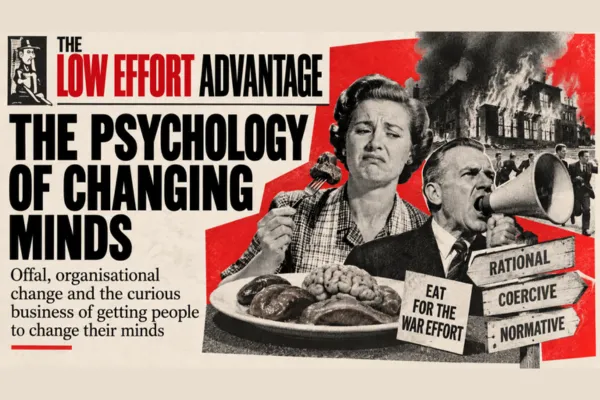
THE PSYCHOLOGY OF CHANGING MINDS
CHANGE DESK
In 1942, Kurt Lewin was given a rather unusual problem. He needed Americans to eat brains. Also kidneys and hearts. Vegetarian readers are advised that this situation continues for approximately four paragraphs. I’d pop the kettle on and come back when we get to the psychology bit.
America was at war. The armed forces needed meat, and the government wanted families at home to make better use of the bits of animals they normally avoided. So Lewin, one of the twentieth century's most influential psychologists, was asked to help.
He began with the obvious solution: explain it to people.
A group listened to an expert explain why these meats were nutritious, why eating them mattered to the war effort and how to make them rather less alarming at dinner. They were given recipes and told how to deal with the taste, smell and texture.
It was rational, informative and, in many ways, an extremely good presentation. Of course, PowerPoint wouldn’t be invented for another 45 years, which was a shame. A tasteful dissolve from kidneys to liver might have changed everything.
A week later, Lewin checked. Of the 41 people who’d received the expert advice, just four had actually served one of the meats at home. Ten per cent.
So Lewin tried something different. Another group received much the same information, but instead of an expert simply telling them what to do, they were encouraged to work it out together. They discussed what was stopping them. The smell of kidneys was apparently an issue. So was the slightly more delicate question of how you persuade your family that what’s just arrived on the dinner table is a perfectly normal thing to eat.
MARS BAR LATEST
If you’re not in Scotland right now, you may be wondering whether this is also how we invented the deep-fried Mars bar. No. That came much later. The official story says a schoolboy asked a chip shop in Stonehaven to batter one in 1992. I say “official story” because my late parents-in-law owned three fish-and-chip shops and maintained that they invented it.
I never challenged this. Some family disputes simply aren’t worth the calories.
Anyway, back to the kidneys.
The group discussed the problems, found ways around them, and then decided whether to try it. A week later, Lewin checked again.
This time 23 of the 44 in the group had served one of the meats. Fifty-two per cent.
Same problem. Much the same information. Very different result.
Lewin had stumbled across something organisations are still struggling with 84 years later: telling people why they should change is not the same thing as helping them discover why they should change.
TRIPE CORNER
You may be wondering why I know so much about wartime offal.
My father.
Once a month, usually on a Saturday afternoon, he would cook tripe. For younger readers, tripe is the lining of a cow’s stomach. For everyone else, imagine your father letting off a stink bomb in the kitchen and then suggesting you eat it.
My father did.
Worse, while eating it himself, he would tell me stories about how, during the war, people ate things like this all the time. Apparently this was supposed to help. It did not. When history failed, he would deploy his most powerful piece of behavioural science: “Real boys eat tripe, son.”
I didn’t.
Looking back, this may well have been my first encounter with an unsuccessful change programme. Had Geppetto tried the same approach with Pinocchio, he’d probably still be a wooden puppet.
PLUS ÇA CHANGE DEPT
Eighty-four years later, remarkably little has changed.
Take housing. Housing associations have had years of reports, regulation, targets, standards, action plans, process redesigns and improvement programmes. And yet responsive repairs appeared in 80 per cent of the cases investigated by the Housing Ombudsman in its latest annual review. The Ombudsman upheld 72 per cent of findings about repairs. Repairs accounted for 355 findings of severe maladministration.
The recurring problems are remarkably familiar: communication, records, ownership and understanding what is actually happening to the resident.
Housing doesn’t appear to lack lessons. It appears to have a problem making the lessons stick.
Pensions administration isn’t exactly short of information either. It has regulation, governance frameworks, service standards, management information, dashboards and enough acronyms to make NATO look under-managed.
Yet regulators and Ombudsman decisions continue to reveal familiar administration failures while the sector wrestles with technology, data, skills and governance.
These organisations aren’t suffering from a shortage of people telling them things need to improve. They’ve been told. Repeatedly.
So perhaps we’ve been asking the wrong question. Instead of asking how we explain the need for change more convincingly, perhaps we should ask:
What if explanation isn’t the missing ingredient?
CHANGE MANAGEMENT CORNER
Two researchers, Robert Chin and Kenneth Benne, described three broad ways in which we try to change human behaviour.
The first is rational-empirical change. The assumption is beautifully simple: human beings are rational, so show them that something is in their interests and they’ll do it.
Essentially: you should eat this tripe because it’s good for you.
And here’s the annoying thing. It can work, particularly when people are already receptive to the proposed change.
If you already like tripe, believe tripe is nutritious and have been wondering whether Tuesday might perhaps become Tripe Night, my father’s presentation would probably have been devastatingly effective.
“Real boys eat tripe.”
Sold.
But Chin and Benne identified another possibility: power-coercive change.
This is the technical term for “Do it because I said so”, which sounds terribly old-fashioned until the building catches fire.
FIRE NEWS
If the building is burning, this probably isn’t the moment for the Chief Executive to gather everyone around a flipchart and announce: “Before we leave, I’d really like to understand how everyone feels about the fire.”
Perhaps we should have an open and honest discussion with it. There are, after all, two sides to every argument. The fire clearly wants to rage. We would prefer it didn’t. It would be wrong to rush to judgement.
Perhaps there is a compromise in which the fire continues to consume the eastern half of the building while we protect Finance.
And before anybody reaches for an extinguisher, has anyone actually asked the fire how it feels? Perhaps it doesn’t feel heard. Perhaps years of being described as “dangerous”, “destructive” and “an immediate threat to life” have created a psychologically unsafe environment for the fire.
Maybe it doesn’t need another intervention. Maybe it needs a voice, a seat at the table and an opportunity to bring its whole self to work.
Meanwhile, Accounts is on fire.
At some point, somebody has to stand up and say: “Everybody out. Now.”
Sometimes coercion isn’t bad leadership. Sometimes it’s leadership.
Research with crisis-management teams supports something close to this. In familiar crises, directive leadership produced faster decisions and, under those conditions, could improve accuracy. Sometimes the person in charge needs to take charge.
Some organisations aren’t merely burning. In places, it’s been reduced to ashes and carried away on a strong current. Customers are chasing, complaining, calling again, waiting for repairs, waiting for money and waiting for somebody to take responsibility.
Inside the organisation, meanwhile: “Do we think it might be worth reviewing the process?”
Someone else thinks everything is broadly fine. A working group is suggested. A meeting is scheduled.
Biscuits arrive.
There comes a point when leadership has to mean something.
COERCION CLARIFICATION
But here’s the important distinction. I’m not suggesting the Chief Executive stands up and announces: “I know what’s wrong. Here’s what we’re going to change.”
Quite the opposite.
They might say: “I don’t know what’s wrong. But I’m no longer prepared to wait for us to find out.”
We’re not having another meeting about the process. We’re not sitting in a boardroom looking at the operating manual and debating whether we agree with it. We’re going to look at the work, listen to customers, follow real cases from beginning to end, collect the data and understand what is actually happening before deciding what needs to change.
That is coercive.
But notice what’s being coerced. Not the answer. The act of finding out.
The Chief Executive isn’t saying, “I’m right. Follow me.” They’re saying, “None of us knows whether we’re right. So we’re going to go and find out.”
Participation doesn’t mean everybody gets to decide whether reality should be investigated.
The leader mandates the learning. Not the conclusion.
REALITY INTERVENES
And now something interesting has happened. We’ve got them out of the boardroom. We’ve stopped discussing what everybody thinks is happening, stopped consulting the operating manual, stopped admiring the process map and got people into the work.
Which means we can finally stop trying to change their minds. Because now we can let something much more powerful do it for us. Reality.
Chin and Benne had a name for this third kind of change: normative re-educative change.
Admittedly, they could have done something about the name.
In fact, an old consultant I once knew apparently felt it wasn’t quite fancy enough and put the wordipsoin front of it. So it becameipso normative change.
I once watched him explain this to a group of shop-floor workers. They listened politely. Nobody interrupted. But the expression on their faces said something very clearly indeed.
“What a complete idiot.”
So let’s not worry too much about the name. Let’s worry about the principle.
Instead of asking, “How do I persuade these people that they’re wrong?”, it asks a completely different question:
What would they need to experience to discover it for themselves?
EXPERIENCE LATEST
Psychologists Russell Fazio and Dennis Regan provide another clue. And rather wonderfully for our purposes, some of the early research involved a housing crisis.
Students who had direct experience of that crisis developed attitudes that were more closely connected to their subsequent behaviour than people who held apparently similar attitudes without having lived through it. Later experimental work found the same broad effect.
Other work helped explain why. Attitudes formed through direct experience can be more confidently held, more accessible and more predictive of behaviour.
Knowing something and experiencing something aren’t psychologically identical.
Your process map says:
Receive → Assess → Allocate → Repair → Close.
Lovely. Five boxes, four arrows and possibly some tasteful corporate blue.
Now follow an actual customer.
“I’ve already explained this three times.”
Another queue. Another handoff. Another phone call. Another specialist. Another department. Another promise.
Every individual part of the process may even be meeting its SLA, while somewhere at the end of it a customer wonders how an organisation performing so magnificently still hasn’t fixed their bloody boiler.
The process map isn’t necessarily wrong. It’s simply describing a different reality.
One is information about the system.
The other is thesystem.
CONSULTANTS’ NOTES
Over the years, clients have asked me versions of the same perfectly reasonable question: “Why do our managers need to spend days looking at the work? We’ve got process maps, SLAs, performance data and reports. You’re the consultant. Why don’t you review all that and tell us what’s wrong?”
And I could. It would certainly be quicker.
But that misses the most important part of the intervention.
I’m not taking managers into the work because I need their help diagnosing it. I’m taking them because they need the experience.
We listen to actual customer demand, not the categories somebody decided to put into the CRM system three years ago. We follow real cases from beginning to end. We establish what mattered to the customer. How many times did they contact us? How many people touched the case? How long did it actually take? How much demand did the system create by failing to do something, or failing to do it right?
John Seddon’s work describes this kind of intervention as creating a “normative experience”.
The important word, for me, isn’tnormative. It’sexperience.
I’m not standing at the front saying: “Your targets are causing this. Your functional structure is causing that. Your measures are making people behave this way.”
I might believe those things. I might even be right. But that isn’t the point.
The point is to create a method that lets the people running the organisation discover what’s happening for themselves.
The consultant doesn’t provide the revelation.
The method does.
My job isn’t necessarily to give leaders the answer. It’s to design a better way for them to find it.
KIDNEYS: AN UPDATE
Which takes us back to Kurt Lewin, 1942 and the kidneys.
The expert at the front of the room had good information. The argument was rational. The recipes were useful. The people understood what they were being told.
And almost nobody changed what they actually did.
Eighty-four years later, we’ve improved the technology considerably. We have PowerPoint now. Beautiful transitions. Dashboards. Process maps. Transformation programmes. Consultants. Reports explaining why the previous transformation programme didn’t quite transform things.
And we’re still remarkably fond of giving people the lecture.
Perhaps the most powerful way to change someone’s mind isn’t to give them a better argument.
Perhaps it’s to give them a better way of finding out.
I could have looked at the process maps, studied the performance data, written the report and told them what was wrong.
It would have been much quicker.
But then I’d have been the one who learned something.
AND FINALLY...
If, after reading all this, you become inclined to change something, remember the three methods.
Rational change works rather well when the people you’re trying to persuade already broadly agree that the change is a good idea.
There’s nothing necessarily wrong with putting someone’s arm gently up their back every now and again either, particularly when the building really is on fire. Just remember what you’re coercing: the investigation, not the answer.
But if you want people genuinely to reconsider what they believe, give them the opportunity to experience the problem. Let them study it, see it and discover for themselves that what they thought was happening and what is actually happening may be two entirely different things.
Which leaves me with one slightly awkward problem.
I’ve just spent this entire article explaining why telling people things is a rather unreliable way of changing their behaviour.
And then I’ve told you about it.
So this article may have been completely pointless.
Unless, of course, you already agreed with me.
In which case, rational-empirical change suggests it may have worked beautifully.
Fingers crossed.