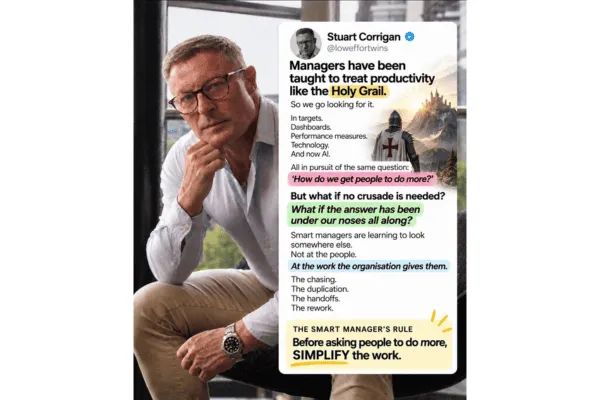
What if your productivity Holy Grail is right at the end of your nose?
What if more productivity is right at the end of your nose?
When I finished The Da Vinci Code, I was rather disappointed.
I’d spent hundreds of pages following Dan Brown halfway across Europe.
Murders.
Codes.
Secret societies.
People being chased through Paris.
All looking for the Holy Grail.
Eventually, after an enormous amount of trouble, we discover where it is.
Apparently…
Two miles up the road from my house.
I felt slightly cheated.
All that travelling.
All those clues.
All those dead people.
And they could have strolled there on a Sunday afternoon.
I thought about this recently for a completely different reason.
There’s something else we’ve spent decades searching for.
Targets.
Dashboards.
Performance management.
Technology.
And now AI.
Productivity.
And still we go looking.
Particularly at the frontline.
How many calls did Sarah take?
How many claims did David process?
Could we shave 30 seconds off each one?
Could AI help them do another three?
It all seems perfectly sensible.
Unless productivity isn’t hiding there.
Because when you follow the work instead of the worker, you start finding things.
A customer calls because nobody called them.
Someone enters information another person already entered.
A case moves between four departments.
A customer chases.
That chase creates another piece of work.
Which somebody now has to process.
And suddenly you realise:
We haven’t got a productivity problem.
We’ve got a work problem.
Simplify the customer journey.
Remove the handoffs.
Remove the duplication.
Remove the failure demand.
Stop creating work that never needed doing.
And boom.
There’s your Holy Grail.
It was under our noses all along.
THE SMART MANAGER’S RULE
Before asking people to do more, SIMPLIFY the work.
P.S. If you belong to a secret society, I’ve always wanted to join one.
https://www.loweffort.com/