Would you like your customers to be more loyal and cost less to serve? Here’s how.
Would you like your customers to be more loyal and cost less to serve? Here’s how.
My kids tell me people like to keep pictures.
Apparently they’re called screenshots.
So I made you one.
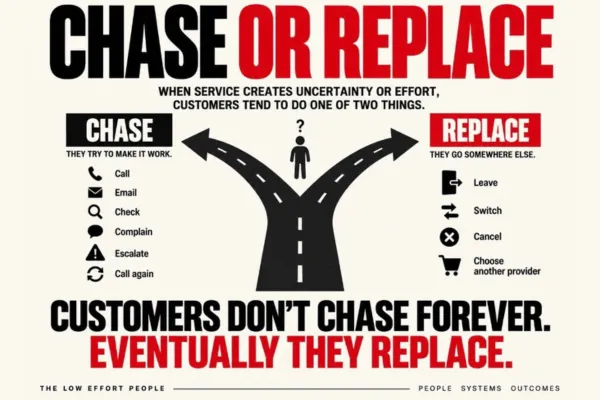
Because there are really only two things customers can do when you make life difficult for them.
They can CHASE.
Call you.
Email you.
Check.
Complain.
Escalate.
Ask what’s happening.
Or they can REPLACE.
Stop chasing.
And find someone easier to deal with.
It even has a natty name.
CHASE OR REPLACE.
82% of UK consumers say they’ve contacted a company more than once to resolve the same issue.
78% say they’re more likely to buy again from companies that make things easy.
And all that chasing isn’t just irritating customers.
It creates work.
Calls. Emails. Complaints. Escalations. Status checks.
We call it failure demand — demand caused because something failed to work for the customer.
And with the average UK inbound call costing around £6.17, it doesn’t take much chasing before “customer service” becomes a surprisingly expensive way of fixing problems you created yourself.
Which is why we built a Failure Demand Calculator.
Put in your numbers.
See what the chasing is costing you.
Then ask the more interesting question:
Why are they having to chase us in the first place?
Customers don’t chase forever.
Eventually they replace.
We’ve built a failure demand calculator. Does what it says on the tin. Calculates the cost of your failure demand.
It’s here.
https://lnkd.in/epMaADn6