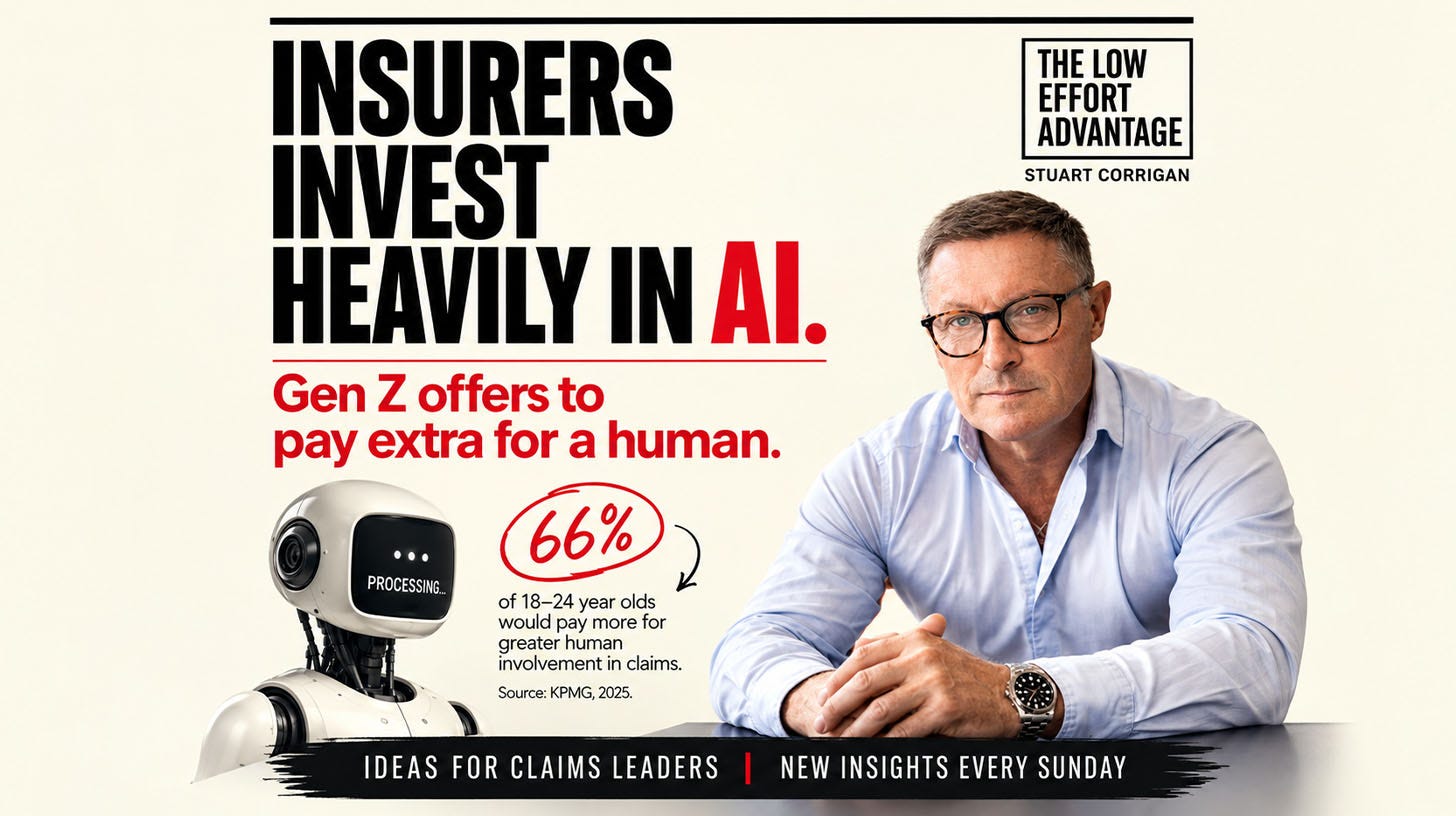
Claims leaders are investing heavily in AI.
Claims leaders are investing heavily in AI.
Two-thirds of 18–24-year-olds say they’d pay more for an insurance policy that guaranteed greater human involvement in their claim.
Yes.
Gen Z.
The generation we keep being told would rather lose a limb than make a phone call. 😂
My youngest jumps when her phone rings.
This is mildly inconvenient.
Because insurers are investing heavily in AI and automation.
Meanwhile, the digital natives appear to be offering to pay extra to put a human back in.
And it isn’t just them.
New KPMG research of 2,000 UK adults found:
90% say human interaction is important in claims.
55% aren’t confident automated claims handling would produce fair and accurate outcomes.
Just 5% are very confident technology alone would deliver a fair and accurate settlement.
Which got me wondering.
Why?
Psychologists have a name for at least part of what may be happening here:
Algorithm aversion.
Research by Dietvorst, Simmons and Massey found something fascinating.
People can lose confidence in an algorithm more quickly after seeing it make a mistake than they do in a human making a mistake.
Even when the algorithm actually performs better overall.
And there’s another clue in their later research.
Give people even a little control over an algorithm’s output and they’re more willing to use it.
Which might tell us something important about claims.
I don’t think the question is:
“Where can we use AI?”
That’s starting in the wrong place.
Nor is it:
“Which parts of the claim still need a human?”
That’s still starting with the solution.
Perhaps we start somewhere much simpler:
What matters to the customer?
Do they need certainty?
Progress?
Ownership?
Resolution?
Understand that first.
Then ask:
How can AI help us deliver it?
Sometimes AI might do almost all of the work.
Sometimes it might make a human dramatically better at doing theirs.
And sometimes what matters most to the customer might be knowing there’s a person who understands their situation and can take ownership when something goes wrong.
That’s not an argument against AI.
Quite the opposite.
It’s an argument for starting with purpose rather than technology.
Because apparently even the generation born with a smartphone in its hand isn’t asking insurers for more AI.
They’re asking insurers to get the claim right.
AI should help us do that.
Tomorrow I’m looking at another number insurers have become rather attached to:
NPS.
And wait until you see John Seddon’s view of it.
If you like ideas about customer behaviour and organisational design applied to insurance, I explore them in more depth in The Low Effort Advantage:
https://www.linkedin.com/newsletters/the-low-effort-advantage-7115709448672657409/
If you want to learn more about creating loyalty through low-effort design, I’ve put the book link below.
New book is on Amazon and is a best seller. https://amzn.eu/d/0d3beYkk
Or You can get a free copy here:
If the problem is urgent, our two-day Claims Workshop will help you identify the core constraint in your operation and build a practical plan to resolve it within 90 days:
Book a call: https://nobacklog.co.uk/claims
#claims #customerexperience #customerloyalty #insurance #loweffortdesign