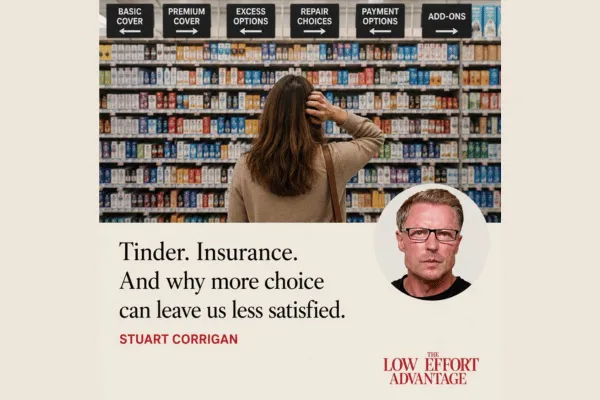
I’ve been missing a fascinating lesson in customer psychology.
I know nothing about Tinder. But I’m told by my pals that I’ve been missing a fascinating lesson in customer psychology.
Apparently, Tinder solved a problem.
And in doing so, may have created another one.
Bear with me.
In the old days, finding a partner required actually finding a partner.
Now, I’m reliably informed, you can sit on your sofa and scroll through hundreds of them.
More people.
More choice.
More chance of finding exactly what you want.
You’d think that would make choosing easier.
It doesn’t necessarily.
Psychologists have studied something called the paradox of choice.
As the number of options increases, so does the work involved in comparing them.
And every choice you make means rejecting another possibility.
Which can leave a little thought behind:
“Maybe the next one would have been better.”
And this is where Tinder starts to have something rather surprising to say about insurance.
Which? surveyed 4,000 UK adults and found 64% think most insurance products offer similar levels of protection.
Think about that for a moment.
You’re confronted with dozens of policies.
They look broadly similar.
You’re not entirely sure what distinguishes them.
So what do you do?
Exactly what any sensible human being would do.
You simplify.
Price.
Brand.
Comparison rankings.
Which? found consumers commonly don’t look far beyond the first few options and rarely interrogate policies in detail.
Hardly surprising.
Nobody wakes up on Saturday morning excited about comparing insurance exclusions.
But it creates an interesting problem for Consumer Duty.
For years we’ve assumed that giving customers more options is customer-centric.
More products.
More channels.
More ways to buy.
More ways to contact us.
More choices throughout the journey.
But giving someone more choice isn’t necessarily the same as helping them make a better choice.
Sometimes we’re not giving customers choice.
We’re giving them homework.
Fortunately, this doesn’t mean taking choice away.
It means being much more thoughtful about the choices we ask customers to make.
Which gives us a useful test.
Don’t ask:
“How much choice are we giving customers?”
Ask:
“Does this choice give the customer more control — or more work?”
Because perhaps the best customer experience isn’t the one with the most options.
It’s the one that makes the right option easier to choose.
PS if you like my weird insights on psychology and work design you’ll get even more from my newsletters.