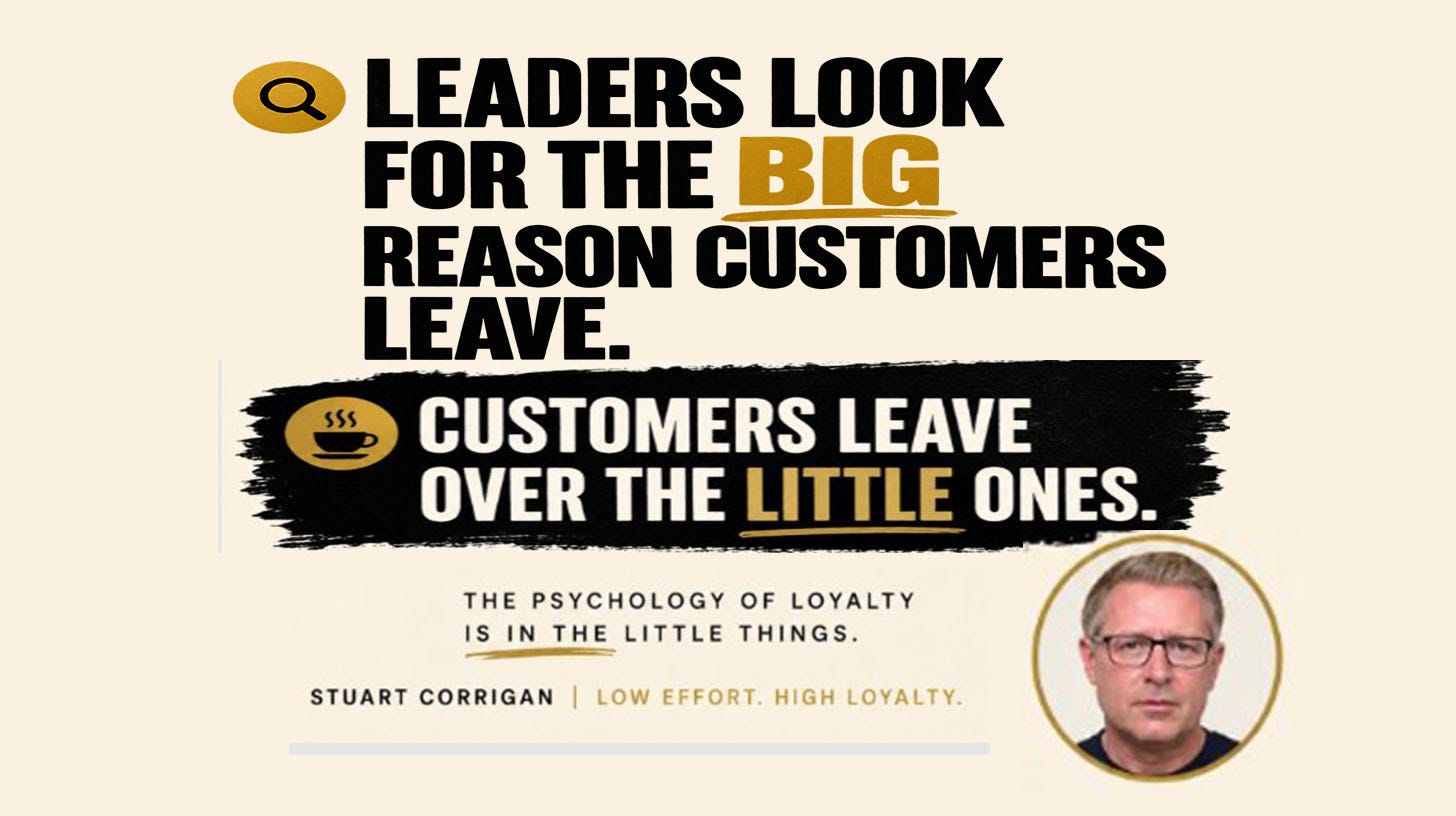
Ella Mai might have accidentally explained why customers leave insurers.
Ella Mai might have accidentally explained why customers leave insurers.
And it has almost nothing to do with insurance.
She has a song called Little Things.
I love it.
But there’s some surprisingly powerful psychology hiding inside it.
Think about the little things we do when someone matters to us.
Remembering how they take their coffee.
Picking something up because you know they’ve run out.
Sending the message you said you’d send.
None of these things seem particularly important.
Until you stop doing them.
Because then something strange happens.
The little thing becomes a big thing.
Not because of the coffee.
Because of what it represented.
You thought about me.
You remembered me.
I matter to you.
And here’s the bit that got me thinking about claims.
A customer calls.
They explain their story.
Tomorrow they call again.
Different person.
So they explain it again.
Next week, someone promises an update.
It doesn’t come.
They chase.
Someone else picks it up.
Another explanation.
Another promise.
Another chase.
We tend to see these as small operational failures.
A missed callback.
A handoff.
A repeat call.
A bit of failure demand.
I don’t think the customer experiences them that way at all.
I think they experience them exactly like we experience the missing little things in a relationship.
As signals.
You don’t remember me.
You weren’t thinking about me.
Maybe I don’t matter very much to you.
And here’s the uncomfortable bit.
We designed it that way.
We broke the customer’s problem into tasks.
Then distributed those tasks across teams, queues and departments.
Everyone can complete their task.
And nobody has to remember the customer.
Which makes me wonder whether we’ve misunderstood ownership.
Perhaps end-to-end ownership isn’t just an operational design principle.
Perhaps it’s a relationship principle.
Because tasks don’t remember people.
People do.
Activate to view larger image,
Subscribe to The Low Effort Advantage for Tuesday’s full article: Why Loyalty Is Too Important to Be Bought.
https://www.linkedin.com/newsletters/the-low-effort-advantage-7115709448672657409/
If you want to learn more about creating loyalty through low-effort design, I’ve put the book link below.
New book is on Amazon and is a best seller. https://amzn.eu/d/0d3beYkk
Or You can get a free copy here:
If the problem is urgent, our two-day Claims Workshop will help you identify the core constraint in your operation and build a practical plan to resolve it within 90 days:
Book a call: https://nobacklog.co.uk/claims
#claims #customerexperience #customerloyalty #insurance #loweffortdesign