Last week I travelled to London on the overnight sleeper.
Last week I travelled to London on the overnight sleeper.
The full Harry Potter experience.
The only things missing were Ron Weasley in the bunk above me and a chocolate frog.
I use the sleeper because I know something important:
It will arrive in London at 6.30am.
Every time.
The journey home?
Noooooo.
I get the last LNER train for much the same reason.
I can work in the first-class lounge beforehand. The train is quiet. I can work on the way home.
I needed three things:
Coffee.
Wi-Fi.
Power.
Coffee?
“Both machines are broken. Sorry.”
Wi-Fi?
“It’s down. Sorry.”
Power?
“We’re operating on low-power mode today. Sorry.”
I was seriously pissed off.
Not simply because the three things had failed.
Because there was no urgency whatsoever about putting them right.
No alternative coffee.
No temporary Wi-Fi.
No way to charge a laptop.
Give me a Starbucks voucher.
Find me a carrier pigeon.
Wire a bicycle to the mains and let me generate my own electricity.
Anything.
LNER currently has an advertising campaign:
“You can go with this. Or you can go with that.”
I didn’t realise they meant:
“Go and do everything yourself.”
Now, here’s where this becomes interesting.
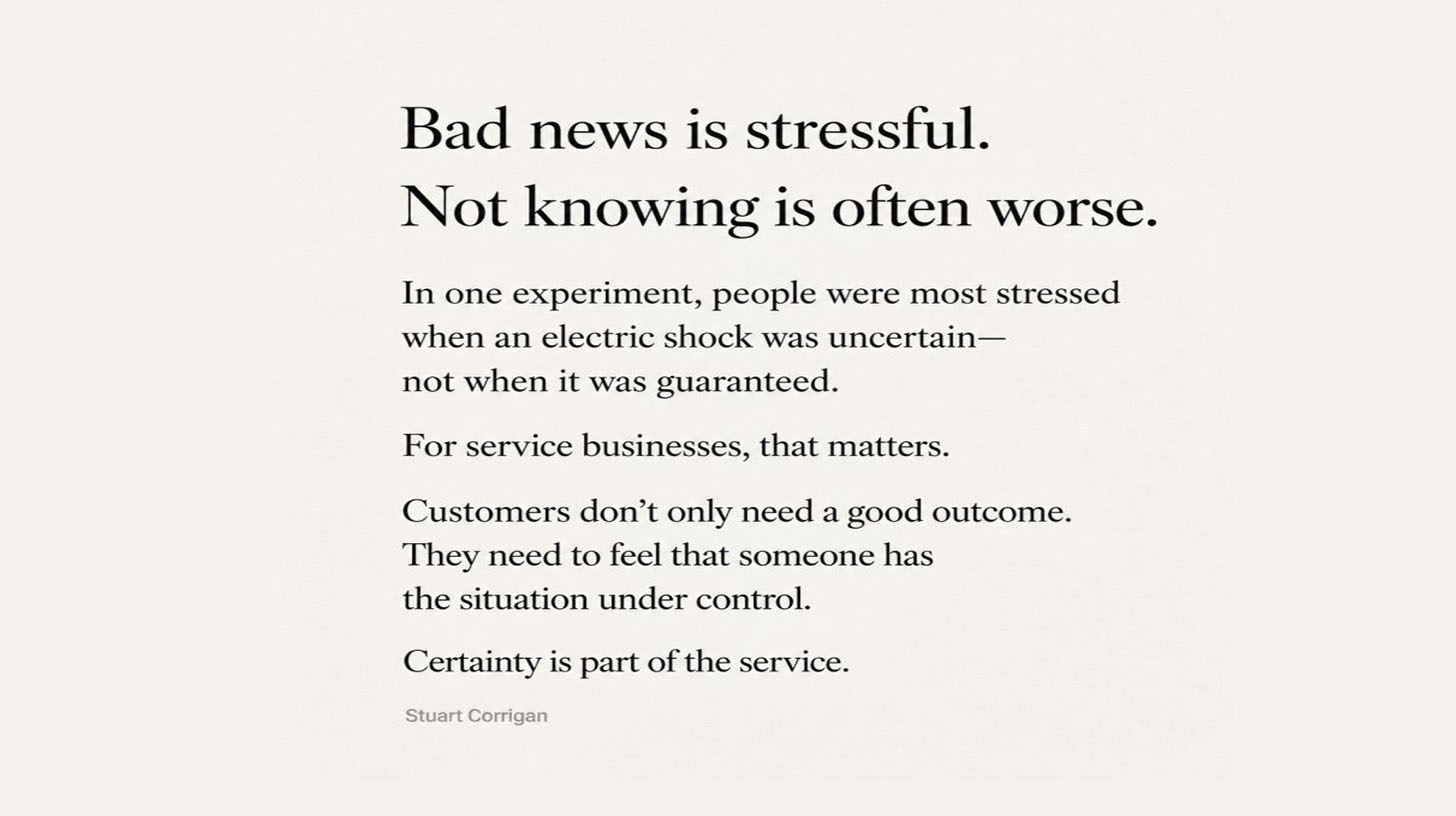
In 2016, researchers at University College London gave people a chance of receiving an electric shock.
Some knew they would be shocked.
Others faced a 50% chance.
The people facing the uncertain outcome were the most stressed.
More stressed than those who knew the bad news was definitely coming.
Their reported stress, pupil dilation and skin conductance all followed the uncertainty.
In other words:
Bad news is stressful.
Not knowing can be worse.
But please don’t read that research and conclude:
“We need a status bar.”
A beautiful tracker showing that nothing is happening is not certainty.
It is simply a more attractive description of failure.
Real certainty begins with understanding what your operation is genuinely capable of delivering.
Then making a promise based on that capability.
Then giving someone ownership of keeping it.
And when coffee, Wi-Fi, power—or an important part of a customer’s claim—repeatedly fails?
Focus on it.
Find the cause.
Remove it.
Check whether it worked.
Then keep focusing until the problem has gone.
Because customers don’t only notice that something failed.
They notice whether anybody appears determined to put it right.
And I think that was what bothered me most.
Not the coffee.
Not the Wi-Fi.
Not the power.
The apparent absence of anybody trying to do something about it.
I’ll unpack the full argument—and what this means for customer loyalty—in Tuesday’s newsletter.
The subscription link is below.
But I’m interested in your experience.
When a service fails, what frustrates you most?
A. The failure itself
B. Not knowing what is happening
C. The sense that nobody is trying to fix it
My answer is C. What’s yours?
Subscribe to The Low Effort Advantage for Tuesday’s full article: Why Loyalty Is Too Important to Be Bought.
https://www.linkedin.com/newsletters/the-low-effort-advantage-7115709448672657409/
If you want to learn more about creating loyalty through low-effort design, I’ve put the book link below.
New book is on Amazon and is a best seller. https://amzn.eu/d/0d3beYkk
Or You can get a free copy here:
If the problem is urgent, our two-day Claims Workshop will help you identify the core constraint in your operation and build a practical plan to resolve it within 90 days:
Book a call: https://nobacklog.co.uk/claims
#servicereliability #customerfrustration #servicerecovery #operationalownership #customertrust