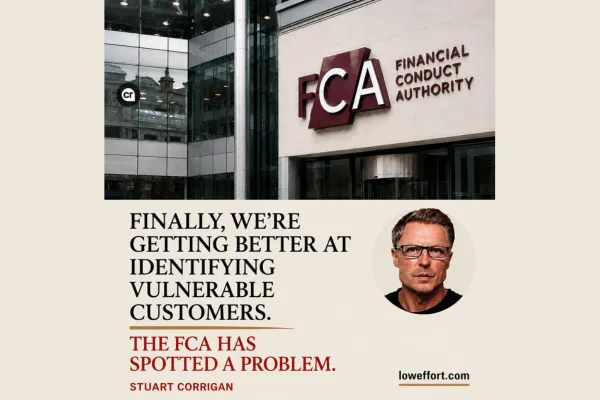
There’s something slightly odd about the way we help vulnerable customers.
There’s something slightly odd about the way we help vulnerable customers.
We identify that they need more help.
Then give them more things to do.
Provide documents.
Chase progress.
Find the right department.
Explain what happened.
Sometimes more than once.
And I think this matters because almost every claims leader I know wants the same thing.
To know that when somebody really needs their organisation, it will look after them.
Not make their life harder.
Which makes what happens next rather uncomfortable.
August research from the Institute and Faculty of Actuaries found that vulnerable customers particularly value empathy, flexibility and clear communication during claims.
Insurers have, quite rightly, invested in this.
People are trained.
Vulnerabilities recorded.
Specialist support provided.
There is just one slight problem.
The customer still has a claim to manage.
The FCA has found examples of vulnerable customers repeatedly providing documents, explaining their circumstances to several staff and contacting firms simply to get updated.
So we’ve arrived somewhere rather peculiar.
We identify someone as vulnerable.
Then give them work to do.
And psychology helps explain why that matters.
Our ability to process information, remember things and make decisions is finite.
Psychologists call it cognitive load.
Stress and uncertainty can make those demands harder.
And few people begin an insurance claim because they’re having an unusually relaxing week.
Their car has been damaged.
Their house has flooded.
They’re ill.
Then the process arrives with admin.
So what do we do?
Management logic offers an entirely reasonable answer.
Make it easier.
Digitise it.
And we should.
Just not yet.
Because there’s a question that comes first.
Should the customer be doing this work at all?
Before making a form easier, ask why they need to complete it.
Before improving an update, ask why they had to chase for one.
Before making another document easier to upload, ask why you need it?
Don’t make unnecessary work easier.
Remove it.
Then digitise what’s left.
So how do you know whether your claims system is actually looking after someone — rather than asking them to look after the claim?
Start with one claim.
Follow it end-to-end.
Record every piece of work the customer had to do to keep it moving.
Every chase.
Every repeat.
Every document.
Then ask one question:
How much of this should the customer ever have needed to do?
Because doing right by vulnerable customers isn’t only about getting better at recognising who needs help.
It’s about designing a claims system that needs less from them when they need the most from us.
Perhaps the kindest claims system isn’t the one that’s best at helping vulnerable customers through complexity.
It’s the one that just removed the complexity.
If you like ideas about customer behaviour and organisational design, explore The Low Effort Advantage.
https://lnkd.in/eHMQXuve