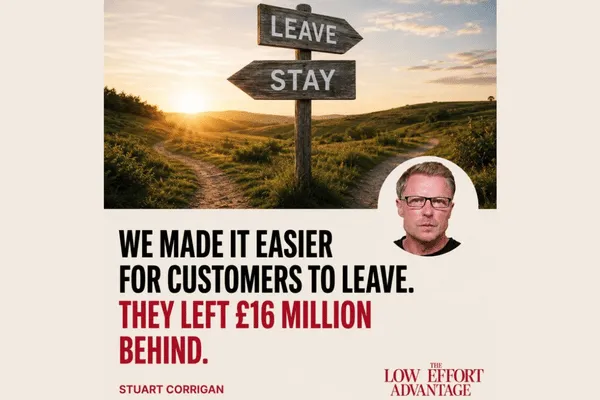
Want to keep more customers? Make it easier for them to leave.
Want to keep more customers? Make it easier for them to leave.
Last year I had a slightly distressing episode at an airport.
Fingerprinting had recently been introduced and, rather inconveniently, I’d entered the country through one airport and was leaving through another.
The customs officer raised an eyebrow.
Worried my Schengen visa was wrong I went straight to ‘strip search.’
Apparently there was no record of me being fingerprinted on the way in.
So he wasn’t terribly keen on letting me out.
Nobody shone a table lamp in my face or threatened me with the office stapler.
But there was a lengthy interview conducted on what appeared to be the assumption that I’d arrived on a power boat in the middle of the night and crawled up the beach with night vision googles.
Now I’m sure me not going back to Denmark won’t break the economy. Though there’s a bottle of Drambuie in hotel in Copenhagen that may go to waste.
But it raises an interesting question for organisations.
Why do they sometimes make it so difficult for us to leave when the consequences can be so bad for them?
Take Virgin Media.
It’s just been fined £28 million after Ofcom investigated how it dealt with customers trying to cancel.
Virgin had two tiers of retention agents.
Tier 1 could persuade you to stay.
But couldn’t cancel your contract.
For that, you needed Tier 2.
More than a million customers had to repeat their cancellation request just to leave.
This wasn’t cancelling a contract. It was tunnelling under the perimeter fence with a dessert spoon.
The logic sounds perfectly sensible.
Want to retain more customers?
Create a retention team.
Measure and reward them.
Until you notice something.
Stopping somebody leaving isn’t the same as making them want to stay.
Using this logic Alcatraz had amazing loyalty.
We worked with an investment firm where it took around 14 days for customers to get their money.
Something odd was happening.
Customers weren’t taking some of their money.
They were taking all of it.
Getting it had been such an ordeal they didn’t want to go through it again.
We changed it.
Customers got their money in 24 hours.
It was easy to leave. They didn’t.
And they started leaving more money behind.
The firm estimated the change saved £16 million in fund value.
Pensions admin next.
Around 1.7 million pension transfers took place in 2025.
Which? found 28% of people they surveyed who tried to transfer described the process as difficult.
One in ten gave up.
Leaving was so difficult that people are forced to stay.
That isn’t loyalty.
Because the customer you really want isn’t the one you stopped from leaving.
It’s the one who knows they can leave — and chooses to stay.
Anyway, next year I’m going to work
in the Bahamas.
Who cares if they won’t let me leave.
PS if you like learning about low effort work - psychology and loyalty, you can get a more in depth understanding in my newsletter.
https://lnkd.in/eHMQXuve