CUSTOMER COMPLAINS ABOUT DELAY - Organisation responds by giving them something else to worry about
CUSTOMER COMPLAINS ABOUT DELAY - Organisation responds by giving them something else to worry about
Here’s a strange bit of customer psychology: you might be worrying about the wrong thing when you piss off a customer. The mistake may not be what loses them. What you do next might.
And strangely, it may explain why some service operations feel permanently out of control.
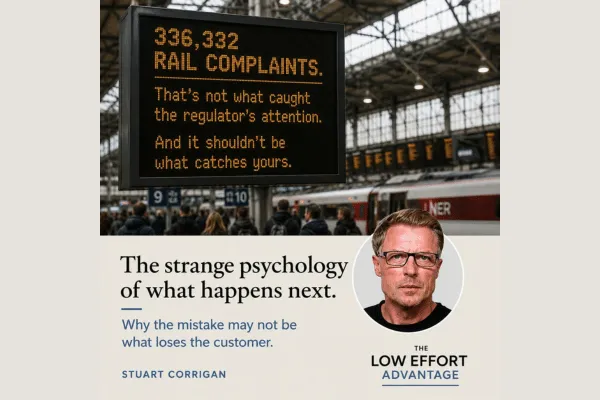
I was reminded of this by 336,332 complaints. That’s how many were closed by UK train operators last year, up 4%. The biggest issue was punctuality and reliability, which will come as reassuring news to anyone worried the British railway had suddenly become unpredictable.
But the regulator’s latest consumer report contained something more interesting. Passengers need accurate and timely information to travel with confidence, especially when things go wrong.
Why should information matter after the thing has already gone wrong?
Recently, I was waiting for the last LNER train home. I needed three things: coffee, Wi-Fi and power.
I got none of them.
Coffee machine broken. Wi-Fi down. Power restricted. An impressive clean sweep.
But that wasn’t what annoyed me. Things go wrong. What annoyed me was what happened next.
Nothing.
No alternative coffee. No temporary Wi-Fi. No way to charge my laptop. Give me a Starbucks voucher. Find me a carrier pigeon. Wire a bicycle to the mains. Anything.
There may be a surprisingly deep psychological reason for this.
In 2016, UCL researchers conducted a slightly terrifying experiment involving electric shocks. Some participants knew they were going to be shocked. Others had a 50% chance.
The people facing uncertainty were more stressed.
That matters in service operations because when something goes wrong, the customer suddenly has a second problem.
Has anyone noticed? Is somebody fixing it? Who owns it? When will something happen? Do I need to chase?
So they try to regain control. They call, email, check, chase and escalate.
And every contact lands back inside the operation.
More work. More interruptions. More noise.
CUSTOMER ATTEMPTS TO REGAIN CONTROL. ORGANISATION LOSES IT.
So if you want to understand why your operation feels out of control, start with one piece of data: what actually happens when a customer chases you?
Pick one chase and follow it. Where does it go? Who picks it up? What does it interrupt? Is it passed on? Passed back? Most importantly, does it move the original problem any closer to resolution?
Because that one piece of demand may reveal something your dashboard never will: how uncertainty outside your organisation creates work inside it.
Perhaps getting control back doesn’t start with another control.
It starts by understanding what happens when the customer tries to take control.
PS if you like my weird insights on psychology and work design you’ll get even more from my newsletters.
https://lnkd.in/eHMQXuve