AI Is the Amplifier, Not the Starting Point
In 2024, Klarna said its AI assistant was doing the work of 700 service agents. A year later the founder admitted quality had slipped, customers had noticed, and the company started hiring humans back.
The technology worked. The decision didn't.
That mistake is about to repeat across thousands of service and SaaS teams — because most are pointing AI at the wrong thing.
The "AI is cheaper" promise is already wobbling.
A Sinch survey this spring found 74% of companies that deployed AI in customer service have since rolled at least part of it back. Gartner now projects the cost of resolving a query with GenAI will pass $3 by 2030 — more than many offshore human agents.
The reason isn't the models. It's sequence. Leaders reach for AI first, to cut cost. It belongs last.
Point AI at a process that works and it makes a good thing cheaper. Point it at a broken one and it makes a bad thing cheaper - at scale.
Most service systems are broken in one specific way
It's called failure demand: the contact your own organisation creates by failing to do it right the first time. The chasing call. The "where's my claim" email. HMRC's own figures put it at 76% of all calls in 2024-25.
Automate a system that's three-quarters failure demand and you don't remove it. You industrialise it. You answer the wrong calls faster.
Low Effort runs in four steps, and AI is the last one:
Study: split your demand into value and failure.
Redesign: remove the failure demand at its cause. This is where the cost comes out. It is not an AI step.
Test: prove the new flow against real demand.
AI Slicing: only now, and only on the clean process that's left
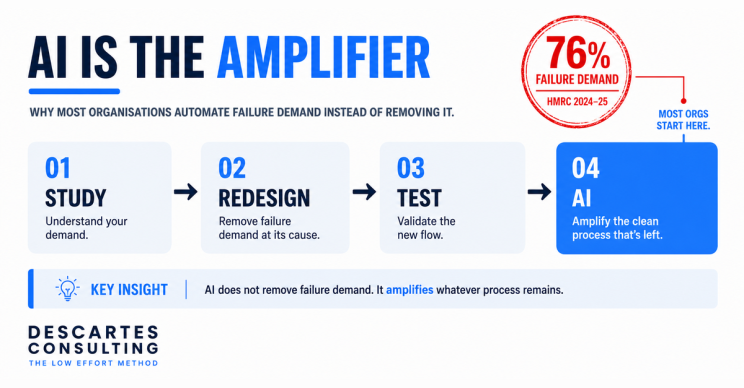
Point AI at failure demand and you don't remove it — you just answer the wrong calls faster.
One test for any AI use case: 'Am I about to automate work that shouldn't exist?' If yes, that's a redesign job, not an AI job.
Before you sign the AI contract, read fifty real contacts and mark each one value or failure. If failure demand is over a third — and it usually is — you have a redesign problem, not an automation problem.
This is the work that has to come before AI
If you're ready to take the next step in your journey to become a low effort organisation, you can get my free book Claims ER: Generate Loyalty and New Customers With Your Claims Department here:
You can get your Low Effort score here:
https://loweffort.com