A different way to improve repairs performance.
Stop trying to get more out of your workers. Start getting more out of the work.
The Low Effort Method helps housing organisations complete more repairs, release capacity, reduce unnecessary work and improve the tenant experience, without simply asking people to work harder.

The shortage of plumbers began to disappear. Eventually, there were occasions when plumbers had nothing to do.
From Housing Repairs ER
A practical method for real results.
A clear, structured way to understand what is happening, redesign the work, prove it works and then expand it across your organisation.
Study the work.
Find out what is really happening, from the tenant's point of view. Use the right data. Confront the brutal facts.
Redesign the work.
Remove unnecessary steps, handoffs and repeat visits. Design around resolving the tenant's problem.
Design stock against demand.
Make the right parts available where the work happens. Stock what you use, in the right quantities, and adjust to actual usage.
With Stock Right NowRun a controlled experiment.
Test the new approach in one trade and one area. Compare the old way with the new. Let the evidence make the case.
Evaluate and expand.
Use real results to decide where to go next. Hardwire the new way of working and roll it out progressively.

From a shortage of plumbers to plumbers with time to spare.
One council was sure it needed more plumbers. When the team followed the work, they found operatives arriving at a home without the part, driving to a builders' merchant, queuing, and driving back. Hours of a working day could disappear around merchant visits.
By redesigning the work and changing how stock was managed, the shortage of plumbers began to disappear, from the same workforce.
- Started with a shortage of plumbers.
- Changed the work. Improved stock. Fewer journeys. More repairs finished in one visit.
- Ended with spare capacity, without asking anyone to work harder.
Within target. Out of patience.
On repairs, the measures landlords run on say the service is working. The tenant's clock says otherwise. Read why
of what residents feel about repair times is explained by "repairs completed within target". 352 large landlords, 2024/25.
Median share of repairs closed without being completed.
Stage-1 complaints per 1,000 homes at the least satisfied landlords against the most satisfied.
Source: Regulator of Social Housing, Tenant Satisfaction Measures 2024/25, Descartes analysis (The Chase Report, Part 1).
Become the most useful source of thinking about housing repairs performance in the UK.
Two free scores.
A few minutes each. The result is yours either way.
How much effort does your repairs service create?
Five readings of your repairs service from the tenant's side, with a report you can share.
Take the Repairs Score →How much repair capacity is hiding in your vans?
The Stock Management Best Practice Score: eight practices, a score out of 100.
Take the Stock Score →Also for voids and allocations.
Straight answers on repairs.
Within target. Out of patience.
Why "completed on time" explains 12% of what residents feel, and what to measure instead.
Read →What does first-time fix actually mean?
The competing definitions, and what each one hides.
Read →The demand your service creates for itself.
Chasing, repeat visits and the tenant as unpaid project manager.
Read →Awaab's Law Phase 2
What changes on 30 November 2026, and why it runs on the tenant's clock.
Read →Housing Repairs ER
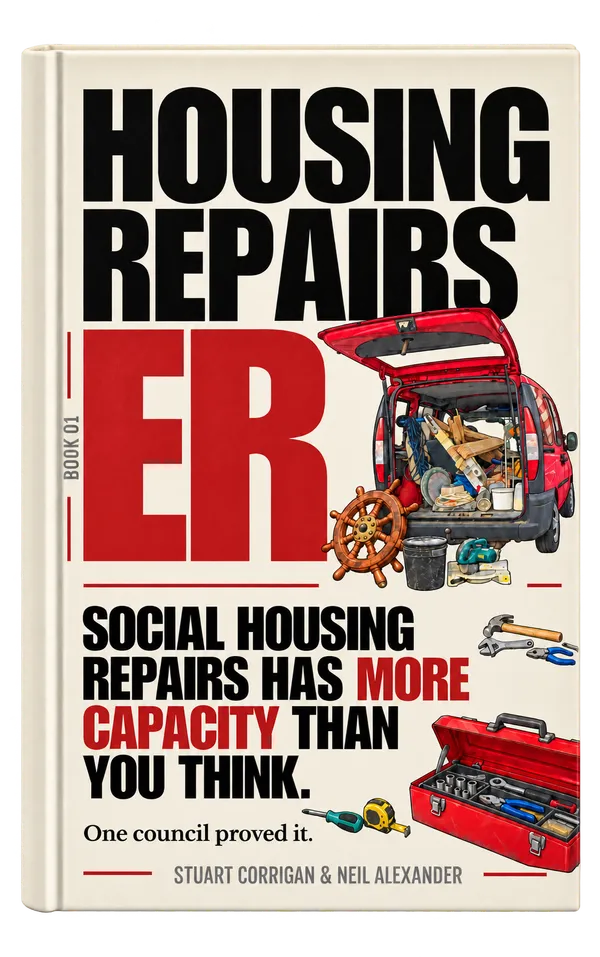
One council's repairs service, told from the car park outwards. By Stuart Corrigan and Neil Alexander.
Whose Clock Is It Anyway?
Why an on-time housing repair can still feel late to the tenant.
Don't Let the Resident Become Your Repairs Manager
Never try to solve a repairs backlog by keeping everyone busy. Oddly, keeping everyone busy may be what creates it.
The Trust Tax
The strange reason a lack of trust may be creating more work than you think.
The Hidden Capacity Briefing
Start with the free presentation: how housing organisations can complete more repairs, without more people, by changing the way the work works. If it speaks to you, you can request a complimentary one-hour discussion with Stuart Corrigan and Neil Alexander from there.
Nine minutes. Free to watch. No sign-up.

© 2026 Descartes Consulting Limited. All rights reserved.
Registered in Scotland under company number SC787331.
Registered office: The Old Station Cowdenburn, Lamancha, West Linton, Borders, Scotland, EH46 7BD.
Descartes Consulting Limited and service providers, including Calendly, process information needed to manage appointments. Do not submit sensitive, financial, medical, pension or other confidential information through booking forms. All content is for general business and educational purposes only and is not legal, financial, pension, tax, actuarial or other regulated advice. Results are not guaranteed, and viewing, booking or contacting us does not create a consulting relationship. Where disclosed, content may be sponsored or contain affiliate links, and we may receive payment, benefits or commission at no extra cost to you. This does not guarantee suitability, and views expressed remain our own. Case studies are illustrative, relate to specific circumstances and do not guarantee similar results. Figures should be read with the stated methodology, period, baseline, conditions and verification status and may not be independently audited.