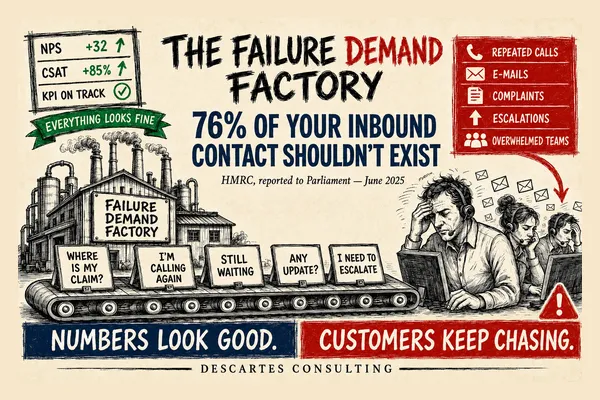
The Accidental Failure Demand Factory In Your Business
No operation sets out to generate its own workload. Most do anyway — and count it as engagement.
Look at this week's numbers. NPS holds. CSAT holds. The dashboard reads on target. The board pack looks fine.
And privately, you might be saying: it doesn't feel like it. Complaints are creeping up. The team is exhausted. Customers tell you they're satisfied — then describe the experience as slow and full of chasing.
The villain isn't your team. It's a measurement system that prizes what's easy to count, and a dashboard that optimises for those numbers. Customers experience what falls outside the count. So they keep coming back.
Why do the dashboards say "on target" when customers say the opposite?
It's wrong that commercial directors own customer outcomes they have no structural means to fix. The instruments they're handed don't see what customers are actually doing.
Across two decades of work in UK service operations — financial services, claims, pensions, NHS administration, local authority — the same pattern keeps appearing. Two decades of watching capable operations leaders blamed for a measurement system that was never going to show them what mattered.
Three beliefs hold the gap in place:
Surveys tell the truth. They don't — that's filtered speech. The work itself is the unfiltered version.
Volume equals demand. It doesn't — in June 2025 HMRC reported to Parliament that 76% of its inbound calls were failure demand.
Fixing this needs a transformation programme. It doesn't — it needs reading the work.
What to do about it: three steps:
Go to the point of contact. Sit there for a day.
Write down what customers actually say, verbatim, not in CRM categories.
Separate value demand from failure demand. The failure share is almost always larger than leadership expects.
Keep measuring what's easy, and the gap widens. Costs creep. Teams burn out. The expensive renewal slips.
Read the work, and the system stops staffing against demand it created. Capacity returns. Customers stop chasing. The numbers and the experience finally agree.
If you’re a claims manager, pensions administration manager, or responsible for a casework system—and want to reduce backlogs, end-to-end times, and operating costs—start with our new book Claims ER: Generate Loyalty and New Customers With Your Claims Department.
It explains how to transform complex claims and casework systems:
Get the book: https://loweffort.com/claimser
If the problem is urgent, our two-day Claims Workshop will help you identify the core constraint in your operation and build a practical plan to resolve it within 90 days:
Book a call: https://loweffort.com