
Could The Social Housing Regulator Be the Good Guy?
I'm going to do something that might surprise people who know my views on regulation, targets and public-sector management.
I'm going to praise a regulator.
In fact, I think the Regulator of Social Housing deserves considerable credit for a change that could profoundly affect the quality and cost of housing services.
The problem is that I'm not sure everyone has understood what has changed.
And there's one important area where I think the regulator still has some work to do.
A different approach to regulation
For decades, public-sector regulation has largely followed a familiar pattern. The regulator decides what organisations should do, specifies the measures and methods they should use, and then inspects whether they've complied.
John Seddon has spent much of his career explaining why this approach can make public services worse.
His argument, developed in his 2024 manifesto Rethinking Regulation, is not simply that organisations spend too much time demonstrating compliance. It's that the requirements themselves can be based on flawed management thinking.
Targets, standardisation, specialisation and attempts to reduce individual transaction costs can all increase the amount of work a service has to do.
Organisations comply with the requirements, but their performance deteriorates. The response is often more inspection, more control and more regulation. Which brings me to something rather interesting.
In April 2024, the Regulator of Social Housing introduced new consumer standards that placed much greater emphasis on the outcomes landlords achieve for tenants.
The regulator wants safe homes, effective repairs, good communication and services that meet tenants' needs.
And, importantly, it largely leaves landlords to decide how best to achieve those outcomes.
This is a significant change in emphasis.
Rather than prescribing the detailed design of a repairs service, the regulator is increasingly asking landlords to demonstrate that their services actually work.
I think that's genuinely forward-thinking.
But have housing leaders changed their thinking?
We've now looked at 199 housing reports and improvement plans. And a familiar pattern keeps appearing. Organisations respond to poor performance or regulatory concerns by introducing more governance meetings, more performance reports, tighter contractor SLAs, additional inspections, more targets and more detailed action plans.
Most of these responses sound perfectly sensible. After all, if something isn't working, surely we need to manage it more closely?
But that assumption deserves examination.
Where does the regulator tell housing associations to create more management meetings? Where does it require them to organise repairs into separate operational queues? Where does it insist on daily productivity targets for operatives or increasingly detailed contractor SLAs?
It doesn't prescribe these methods.
Yet they remain common responses to the pressure to improve. It's a handed-down logic, from the early 1900s, based on systems with low variety. And yet we keep using it.
My concern is that many housing leaders may be interpreting an increasingly outcomes-focused regulatory regime through an old command-and-control view of management.
The regulator asks for better outcomes. The organisation responds by tightening control over the existing way of working. But what if the existing way of working is the problem?
The problem with repair targets
However, one area is where I believe the regulator's thinking deserves a fair challenge.
Repair completion targets.
Landlords must set timescales for repairs, tell tenants what those timescales are, and report the percentage completed within them.
The regulator doesn't impose a single national target for routine repairs. Landlords choose their own timescales.
At first glance, this seems entirely reasonable. Tenants should know when their repairs will be completed, and landlords should be accountable for the promises they make.
But there's a fundamental weakness in using target achievement to judge performance.
Imagine two housing associations, both with a 28-working-day target for routine repairs.
One completes a leaking tap repair on day 27. The other completes an identical repair on day three.
Both are recorded as having met their target.
Yet the tenant in the first property waited nine times longer.
The measure tells us whether the landlord achieved its chosen deadline.
It doesn't tell us how well the repairs system is performing or what it is capable of achieving.
And there's another problem.
The percentage of repairs completed within target only includes repairs recorded as completed. Those still waiting are not included in that particular calculation.
So the performance report can look encouraging while a substantial amount of work remains outstanding.
When the target becomes the purpose
My greater concern is what happens when managers begin using these targets to control the work. We've spent many years studying housing repairs services, and the consequences are depressingly familiar. Work gets divided into categories, each with its own deadlines and queues.
Managers focus attention on jobs approaching their targets. Other work waits.
Operatives are encouraged to complete more jobs, even when the conditions needed to resolve the tenant's problem aren't in place.
And sometimes jobs are recorded as completed before the underlying problem has actually been fixed.
I've seen repairs closed and reopened four or five times.
Each closure can make the management figures look better, but the tenant is still waiting for the original repair.
The tenant calls again. Another appointment is arranged. Someone else visits. More time and money are spent. The computer records several transactions. The tenant experiences one problem that nobody has properly resolved.
This is what happens when the measure begins to replace the service's purpose.
And it's precisely the kind of management thinking I've been writing about.
The regulator's own figures tell an interesting story
The regulator's 2025/26 Tenant Satisfaction Measures show that 82.9% of non-emergency repairs were completed within landlords' own target timescales.
That sounds reasonably encouraging.
But the same publication also reports more than 1.2 million responsive repairs still in progress at year-end.
It also records more than 2.6 million cancelled repairs. Many of those cancellations may have perfectly legitimate reasons, so we shouldn't assume they represent unfinished work.
Look at an end-to-end chart of the time to close repairs. It can take up to 1000 days to close a repair. What would be the point of setting a target of 28 days here?
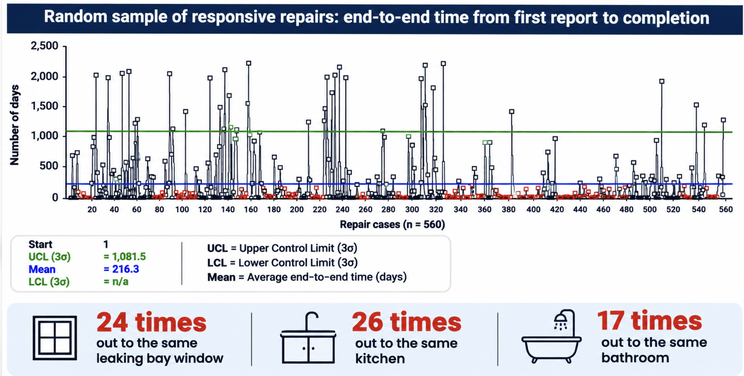
Figure 1 - Data collected over time shows the actual time it takes to close real repairs.
Nevertheless, the figures raise an important question.
How much do we really learn about the effectiveness of a repairs service from the percentage of completed jobs that met a deadline?
To the regulator's credit, it now provides additional information and recognises that this percentage doesn't tell the whole story.
I think that's a welcome development.
But I'd go one step further.
What if we measured what repairs systems are actually capable of achieving?
Suppose we kept the regulator's required targets for reporting and accountability. But stopped using those targets as the main way of managing repairs. Instead, we started with a much more useful question.
How long does it actually take to complete a repair, from the tenant's first contact until the problem is fully resolved? (above you can see it takes 1081 days or less).
Not how long someone has been allowed to take.
How long does it really take?
We would study completed repairs and those still outstanding. We'd look at the variation in completion times, the number of visits required and the reasons work gets delayed.
Then we'd change how the work is organised to remove the causes of poor performance.
This is systems thinking.
In one of our housing repairs projects, the average end-to-end time for first-time-fix repairs fell from around hundreds of days to under twenty. And look at what happened to costs.
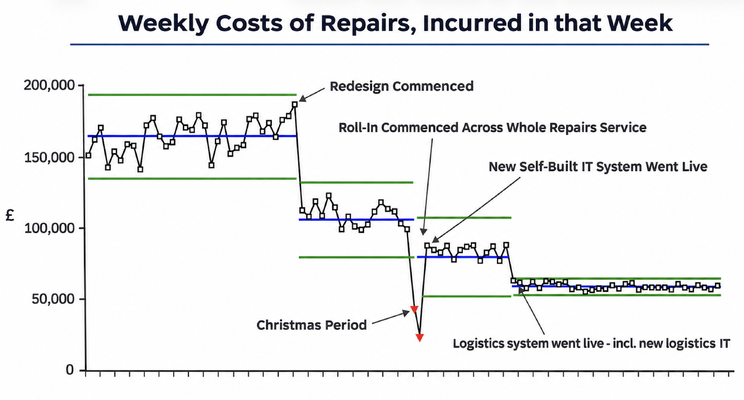
Figure 2: Actual end-to-end repair costs reduced after implementing a new work design and van stock management.
We didn't achieve that by setting tougher targets or holding more governance meetings.
We achieved it by studying the work and changing the system.The effect was not simply faster repairs. We also released significant capacity from the existing workforce and reduced unnecessary costs.
Now consider what that means for regulation.
If a housing association develops a repairs system capable of completing work in days rather than weeks, meeting its regulator repairs target becomes considerably easier.
The improvement comes first. The achievement follows.
A better outcome for everyone
None of this requires landlords to ignore the regulator.
But they should be having open conversations about actual repair timescales, and the disucssing ways of working to improve performance.
But reporting performance and managing performance are not the same thing.
The regulator could retain its existing reporting requirements while giving much greater weight to evidence of actual system capability.
How long are tenants really waiting? Are completion times improving? Is outstanding work falling? Are repairs being resolved properly, with fewer repeat visits?
These questions tell us far more about whether a service is getting better.
And this is where I believe everyone can win.
Tenants receive faster, more reliable repairs.
Housing associations reduce unnecessary work, improve productivity and make better use of their resources.
And the regulator gets what it ultimately wants: safer homes, better tenant outcomes and convincing evidence that services are improving.
Perhaps the regulator is ahead of us
I believe the Regulator of Social Housing deserves genuine credit for the direction it has taken.
Its move towards outcomes, local responsibility and evidence of improvement is an important departure from much of the thinking that has dominated public-sector management for decades.
I would encourage it to finish the job by reconsidering the weight it gives to repair completion targets and giving greater emphasis to actual system capability.
But I would also challenge housing leaders.
The regulator has given you considerable freedom to decide how best to improve your services.
Yet many organisations continue responding to poor performance with the same targets, controls, reports and management practices they've relied on for years.
Perhaps the biggest obstacle to better housing repairs isn't the regulation itself.
Perhaps it's the thinking we use to interpret it.
The regulator has started to move on. Have we?
Question the plan.
Note we are going on the road to share our method. Look out for an event near you soon. Want your team exposed to this way of thinking - DM me.